Sometimes on the internet we need to dispel some misconceptions and misinformation prevalent in media outlets. Here you will find quotes and resources to clear any of this up.
Any additional information I find will be added as I find them.
Misconception: The Expanded Universe was Never Canon
Marketing
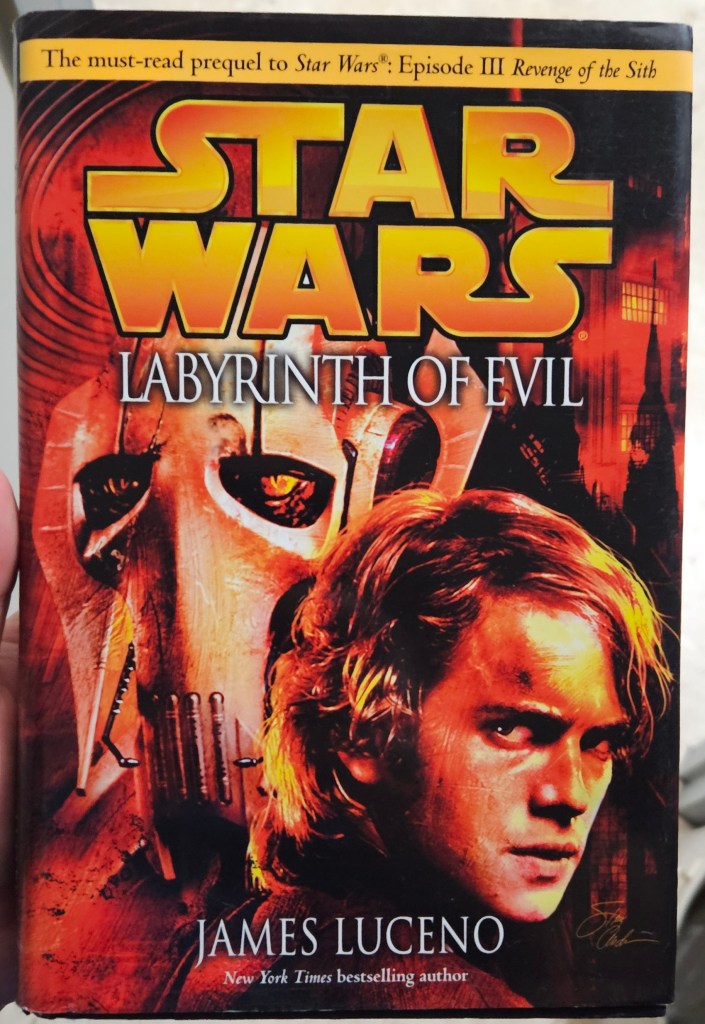
“The must-read prequel to Star Wars: Episode III Revenge of the Sith“ – Labyrinth of Evil (2005), by James Luceno
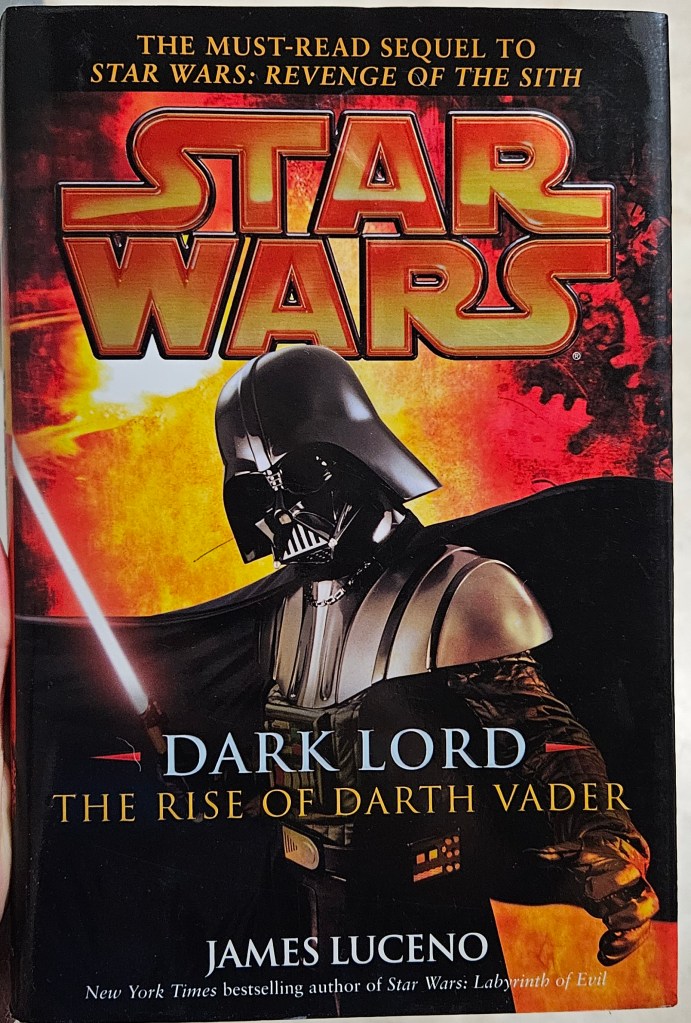
“The must-read sequel to Star Wars: Episode III Revenge of the Sith” – Dark Lord: The Rise of Darth Vader (2005), by James Luceno
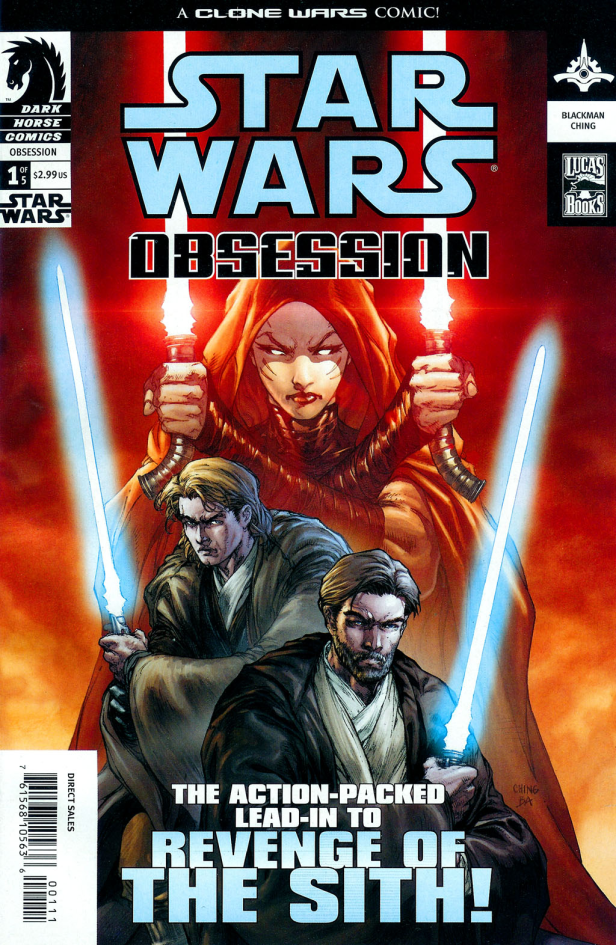
‘The action-packed lead-in to Revenge of the Sith!” – Obsession Issue 1, 2004
Quotes
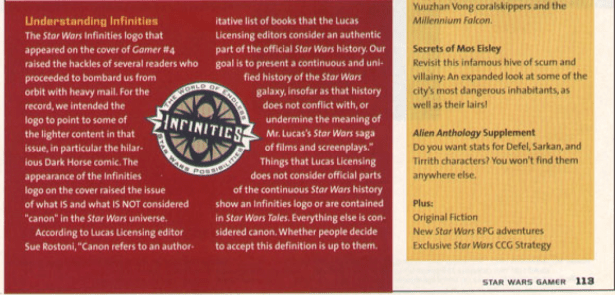
“Canon refers to an authoritative list of books that the Lucas Licensing editors consider an authentic part of the official Star Wars history. Our goal is to present a continuous and unified history of the Star Wars galaxy, insofar as that history does not conflict with, or undermine the meaning of Mr. Lucas’s Star Wars saga of films and screenplays.”
– Understanding Infinities, Sue Rostoni, Lucas Licensing Editor, Star Wars Gamer #6 (2001), pg. 113
“When asked if the G and C-levels formed separate and independent canon, Chee responded by stating that both were part of a single canon: “There is one overall continuity.””-Leland Chee, Continuity Database administrator aka Keeper of the Holocron for Lucas Licensing, August 4, 2004
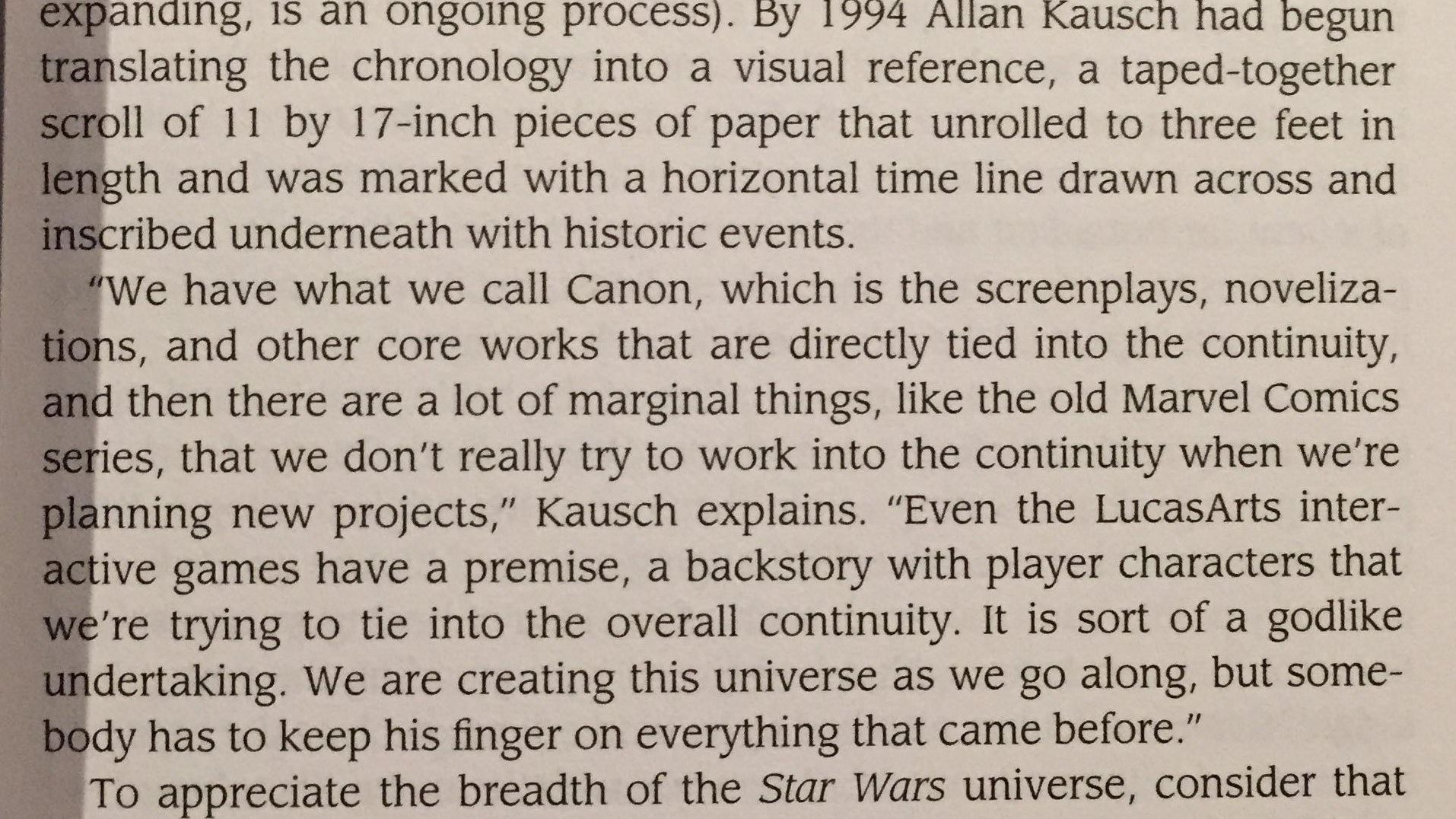
“We have what we call Canon, which is the screenplays, the novelizations, and other core works that are tied into the continuity, and then there are a lot of marginal things, like the old Marvel Comics Series that we don’t try to work into the continuity when we’re planning new projects,” Kaush explains. “Even the LucasArts interactive games have a premise, a backstory with player characters that we’re trying to tie into the overall continuity. It is sort of a godlike undertaking. We are creating this universe as we go along, but somebody has to keep his finger on all that has gone before.
– Allen Kaush, interview with Mark Cotta Vaz, Secrets of Shadows of the Empire (1996)
“Basically, everything except those items marked with an “Infinity” logo (i.e. the Star Wars Tales comics) is considered canon.”
– Sue Rostoni, Lucas Books and Lucas Licensing Managing Editor, Starwars.com May 30, 2003 (WAYBACK MACHINE LINK BROKEN)
“Officially everything in the Star Wars publishing universe is canon, though George Lucas retains creator privileges to override anything he wants. Lucasfilm employs a “Keeper of the Holocron,” namely Leland Chee, to keep it all straight. In this Star Wars is unique from most other franchises. DC, for example, keeps the Batman comics separate from The Dark Knight movie and Arkham Asylum the video game.”
– Interview with Daniel Wallace on writing The Jedi Path. TIME Interviews Q&A With Jedi Path Author Daniel Wallace, Aug 24, 2010

“Lucasfilm and Bantam decided that future novels in the series would be interconnected: that is, events in one novel would have consequences in the others. You might say that each Bantam Star Wars novel, enjoyable on its own, is also a part of a larger tale.”
– Statement in the original prints of the Bantam Star Wars books
“The idea (licensing deal with Bantam) was passed to George Lucas who agreed that licensing could expand upon the films with original fiction set after Return of the Jedi….”
-Star Wars Insider #59, June 2002, pg. 68
” In the early days of the publishing department Wilson worked closely with her administrative assistant Sue Rostoni (Now managing editor of the department as well as adult fiction) on editorial projects. The two of them decided that to maintain quality it would be crucial to monitor the storylines of all projects to ensure that none of their books contradicted one another. This continuity decision became one of the department’s biggest challenges and greatest successes.”
-Star Wars Insider #59, June 2002, pg. 69
‘Gospel’, or canon as we refer to it, includes the screenplays, the films, the radio dramas the the novelizations. These works spin out of George Lucas’ original storues, the rest are created by other writers. However, between us, we’ve read everything, and much of it is taken into account in the overall continuity. The entire catalog of p[ublished works comprises a vast history – with many off-shoots, variations and tangents – like any other well-developed mythology.
– Allan Kausch, Star Wars Insider #23, Autumn/Fall 1994, pg. 18
“This is perhaps the most exciting part of working on the Journal: expanding the breadth of the Star Wars universe. Since it’s a licensed publication, all the material becomes an official part of the continuity.” – Peter Schweighofer, editor of the Star Wars Adventure Journal, Introduction to Star Wars: Tales From the Empire (1997), pg. xxv
“…once their works were published, the events they narrated became part of Star Wars continuity” – Introduction to Star Wars: Tales From the Empire (1997), pg. xv
“The company [West End Games] has coordinated its efforts with lucasfilm and other Star Wars licensees to guarantee the continuity and retain the spirit of Star Wars in it’s products” – Introduction to Star Wars: Tales From the Empire (1997) pg. xiii
“’We set parameters,’ Roffman says. “It had to be an important extension of the continuity, and it had to have an internal integrity with the events portrayed in the films.” Closely tending the canon was paying off with fans. Essentially, all the new comic books, novels, and games were prequels and sequels of one another”-Howard Roffman, President of Lucas Licensing, Interview with thewire.com August 2008
Secondary source: The Wired, Meet Leeland Chee, The Star Wars Franchise Continuity Cop.
Bantha Tracks: When you started work on EWOKS AND DRIODS you must have watched a lot of Saturday morning cartoon shows to get a feel for things:
Miki Herman: Yes, but I lost interest in them very quickly. I didn’t find that other shows are a measure of what we’re aiming to achieve. You see, George Lucas wants to raise the standards of Saturday moirning programming for children.
His main complaint with most of the current programming is the acting. Everybody sounds alike whether it’s a crisis or a happy event. And, all the same voices are used over and over again. Good acting can even save a cartoon that doesn’t have a really sophisticated animation. Some of George’s favorite shows were pretty limited in their animation; but the writing, performances and characters were great. We’re going for both better acting and character work.
We also want to put real feelings into the show: happy feelings, some sadness and comedy, humor. The shows will be funny. Comedy is very important to us.
BT: Will the stories you tell with the new shows move into the realm of the first three Star Wars movies? Is there some sort of historical perspective with the existing Star Wars Saga?
MH: It is the same universe as Star Wars. But this is an attempt to spin off, to create new characters. We want to take the droids, who are very funny characters, and throw them into new situations with new masters. With EWOKS we’ll explore thew hole moon of Endor and all the creatures that live on it, new characters, new villians, comedic villians.
“(Starburst Magazine)SB: ‘How much involvement did LucasFilm have with the project? Did you have freedom to do as you pleased or did everything have to be vetted?’
(Aniel Erickson)AE: ‘Everything is vetted through LucasFilm but there were few issues and I can’t remember a single veto. We’re creating a love letter to Star Wars with SWTOR so it’s pretty easy to stay within the boundaries LucasFilm wants products in.’
SB: ‘So there weren’t any aspects of the Star Wars universe that were off limits?;
AE: ‘There was very little that was out of bounds. I remember we explored the idea of having Dagobah in the game and we learned you can’t explain the tree or most of the interesting parts of the planet so we decided to leave it out for now. LucasFilm is keeping a few things back for itself.’
SB: ‘Has there been any reaction from George Lucas himself?
AE: George has seen the game and given positive feedback. He obviously has final say on all the Star Wars products.’” Interview with Star Wars: The Old Republic – Writing Director Aniel Erickson by STARBURST Magazine – December 14, 2011 – full interview here.
Misconception: George Lucas didn’t care about the Expanded Universe
MH: George told us what we wants the shows to be. What his hopes for them are. But he hasn’t written stories for it or had a day to day involvement in the project. As work progresses and we get rough-cuts, we screen and go over them together. And, as I said, there were specific assignments on things like acting, animation, writing that came from George. They are the standards he set.
George Lucas wrote the story and Bob Carrau wrote the script based on George’s story. ~ Tom Smith, General Manager ILM, interview, Bantha Tracks Number 25, Summer 1984. On Caravan of Courage
“Be assured that nothing Star Wars related that Dark Horse publishes escapes the scrutiny of Mr. Lucas” – Bob Cooper, editor for Dark Horse Comics Classic, letter to the editor section of Classic Star Wars #8, April 1993
“New developments in even the remotest corners of the Star Wars universe are always approved by Lucas himself. The continuity editors send him checklists of potential events, and Lucas checks yes or no. “When Bantam wanted to do the back story on Yoda,” Dupree said, “George said that was off limits, because he wanted him to remain a mysterious character. But George has made available some time between the start of Episode Four, when Han Solo is a young pilot on the planet Corellia, and the end of the prequel, so we’re working with that now.””
-John Seabrook, Writer for the New Yorker, Why is the force is still with us? article from the New Yorker January 6, 1997
“Lucas’s day-to-day activities in the main house include the management of the Star Wars story, which is probably the most carefully tended secular story on Earth. Unlike Star Trek, which is a series of episodes connected by no central narrative, Star Wars is a single story–“a finite, expanding universe,” in the words of Tom Dupree, who edits Bantam’s Star Wars novels in New York. Everyone in the content-creating galaxy of Star Wars has a copy of “The Bible,” a burgeoning canonical document(currently a hundred and seventy pages long) that is maintained by “continuity editors” Allan Kausch and Sue Rostoni. It is a chronology of all the events that have ever occurred in the Star Wars universe, in all the films, books, CD-roms, Nintendo games, comic books, and role-playing guides, and each medium is seamlessly coordinated with the others.”
-John Seabrook, Writer for the New Yorker, Why is the force is still with us? article from the New Yorker January 6, 1997
“George was involved in the early stages . When the book was first proposed, I wrote to him and asked whether there was any reason why Plagueis couldn’t be a non-human, and he wrote back that Plagueis could be a Muun and sent me some artist renderings of the character. From that point on, everything was approved, as they’re saying, “at the highest level.” I worked most closely with George’s right-hand man at Lucas licensing, Howard Roffman. It was a strange way to go about the book, because I kind of had to bypass both Del Rey and the usual editorial staff at Lucasfilm and work directly with Howard over the course of what amounted to about a year of preparation.”
– Interview with James Luceno, TheForce.net, January 10, 2012
“I received from LFL a Word document of Revenge of the Sith with Mr Lucas’ edits, which was distinct from the edits I’d already gotten from Sue Rostoni and Howard Roffman and the rest of the LFL crew, and this document was edited in such a detailed fashion that even individual words had been struck off and his preferred replacements inserted, as well as some passages wholly excised and some dialogue replaced with the dialogue from the screenplay. If that’s not line-editing, I don’t know what is.
What’s in that book is there because Mr. Lucas wanted it to be there. What’s not in that book is not there because Mr. Lucas wanted it gone. Period.
– Matthew Stover on The Force.net: The Official Matthew Woodring Stover Discussion Thread, 2006.
“Rather than forbid each of us to get into those mysterious areas, it was decided that we should submit questionnaires to George Lucas. Basically, we would make up long lists of ideas we wanted to use and he would check “OK” or “Not OK” next to each idea. For example, I made a long list of possible powers that the ancient Jedi possessed. He vetoed most of them but okayed some rather interesting ones, such as the ability to “study the qualities of animals and acquire those qualities. He also okayed the use of Jedi Battle Meditation – the ability to influence events by interior visualization. – Tom Veitch, “Telling Tales” interview with Dan Wallace for Star Wars Galaxy Magazine. Issue 13, November 1997
“I knew going into the project that I couldn’t create a backstory for Palpatine, but I had Mr. Lucas’s permission to depict Palpatine as a consummate manipulator and master politician.”
“In his instructions, Mr. Lucas stated up front that he wanted a political thriller that focused on Palpatine and Valorum…”
– Behind the Cloak: James Luceno, starwars.com.

“We went through George Lucas and he signed off on each point. When he got done, he wrote me a little note that said, “Great job, I can’t wait to see it!” It was that easy to get through the approval process. Of course, once you write the story, they read to make sure you wrote what you said you would, and it’s up to their standards. Really, it was a painless process that was pretty much all of my creation and I just felt lucky and grateful George Lucas signed off on it!
– Dave Wolverton interview by Doug McCausland (IG_2000) on November 17. 2014 on the Force.net.

“In my original proposal for the “Jedi Academy” trilogy, I had suggested that Exar Kun could be the spirit of a long-dead dark Jedi or a Dark Lord of the Sith that had fallen centuries ago. George Lucas said he wanted me to use a Dark Lord of the Sith. I found that very exciting for about ten seconds, until I realized I didn’t know anything about the Dark Lords of the Sith. In order to learn more, Tom Veitch (who was interested in the same information for his comics) and I put together a questionnaire where George could give us some insights into how we should develop the background. Based on George’s answers, we put together the history. You can read many of the details in my comic series with Tom, Dark Lords of the Sith, plus my own six issues of “The Sith War” and “The Golden Age of the Sith.””
– Kevin J. Anderson Interview here.
“I had four hours with George Lucas, when we were able to discuss at length all the questions I had regarding what I’d read in the script, and to have him give me some feedback on what he’d like to see happen in the book.
This is the first time I discovered that what he was looking for was not a traditional novelization of the sort we’re all familiar with, but an adaption in which you would expand well beyond the boundaries of what the movie would cover.” ~ Terry Brooks on consulting George Lucas in writing the Phantom Menace (adult) novelization. Star Wars Insider #39
What kinds of things were you told not to develop?
That would be something he’s going to develop in the other movies, or because they’d be better developed in another book…he just said don’t go into this particular area. ~ Terry Brooks on consulting George Lucas in writing the Phantom Menace (adult) novelization. Star Wars Insider #39
There are entirely new chapters in this book, in which everything’s invented, and it’s mostly about Anakin. There’s also stuff on some of the other characters, too, that’s not in the movie at all. The genesis for this was mostly from George, but he didn’t say, “This is the way that I want you to do it, follow these rules.” He basically said, “Go do something with this.” ~ Terry Brooks on consulting George Lucas in writing the Phantom Menace (adult) novelization. Star Wars Insider #39
“I came on board the New Jedi Order project at the very last minute. I was working on Demon Wars for Del Rey at the time and they had won the licensing deal from Lucas. They asked me to do the first book, and it was an honor. So I gathered all the information of the meta-story – point A-to-B in a series going to Z, and cobbled together a detailed outline. I was in a conference call with Del Rey and Lucasfilm when the editors expressed that they loved the outline. (paraphrasing here) “This is exactly what we want, but didn’t anyone tell you? You have to kill Chewey.”I won’t type the next two words that came out of my mouth. After a couple of days of arguments and, well, terror, they had convinced me that they were doing it for the right reasons, and well, George was down with it, and it’s his galaxy far, far away, so I did it.The responses have been mixed, with some people loving the new direction, other people devastated. I think it might be the only thing I’ve ever regretted; I don’t think I’d go back and do that one again.”
– R. A. Salvatore interview on Reddit
“LucasBooks has always checked with the boss to make sure that none of its projects interferes in any way with anything that he is planning. And while plans can change, rest assured that the wonderful expanded fictional universe enjoyed by so many fans has in no way stomped or trampled on any of George Lucas’s prerogatives or options.”-Steve Sansweet, Director of content management and had of fan relations at Lucasfilm, starwars.com November, 2000
The Clone Wars are a major event in the history of the Star Wars Universe and because its a war there is a lot of action and a lot of adventure and a lot of things going on. But in the films we don’t really get to deal with that very much. We kind of start the clone war in one episode we end it in the next episode but we never actually see the war. And so, uh, by doing the animated series, it was a great opportunity to fill in some of the blanks in the middle… where you get to deal with the adventures of the war and all the things that went on during the war because obviously that’s a very fertile ground for exciting storytelling. – George Lucas, Bridging the Saga, Star Wars Clone Wars DVD Featurette
“I’m very interested in anime and I was really interested into moving into a kind of animation that was very different from anything we’d done in the past. And Genndy is very good at bridging that transition between traditional animation and anime.
– George Lucas, Bridging the Saga, Star Wars Clone Wars DVD Featurette
When we first did Grievous we had very little information about him, he was just being conceived as a main villain for episode 3. But for this really had to explore him more, and George told me about he had some thoughts about that he was an old style villain where he fights but then when he’s losing he runs away.
How does he know to use lightsabers? That’s supposed to be a special gift. You’re supposed to be force-sensitive. George told me “Maybe Count Dooku teaches him”.
Then we got a call that they wanted to introduce Grievous’ cough earlier, ’cause our character didn’t have it. So we somehow had to maybe link the two together better. So eventually we ended up doing a little sequence maybe two weeks before we had to deliver of Mace going out and crushing Grievous’ chest, and that’s what gives him the connection that all of a sudden he starts coughing.
– Genndy Tartakovsky, Connecting the Dots, Star Wars Clone Wars Volume 2 DVD Featurette
The Dark Forces team was about three months into the development cycle when they submitted their story outline, character bios and sketches, and some preliminary gameplay to Lucasflim Licensing, which subsequently presented the material to George Lucas….
“We showed them to George, and even though the designs were interesting, there was some question as to whether they were consistent with the Empire. We brought that feedback back to the team, and a re-design was done”…
“This is the exact kind of evoluition that George goes through with the designers on the Star Wars films”
-Star Wars Insider #23, Autumn/Fall 1994, pg. 15
Misconception: George Lucas Always Planned to do a Sequel Trilogy

“Lucas admitted to the audience “to be very honest with you, I never ever thought of anything [I want to tell] that happened beyond Episode VI. It’s the Darth Vader story.””
– Star Wars The Ultimate Visual Guide: Updated and Expanded (2012), pg. 182
Earlier mentions have said about a 9 movie saga, but this is the most recent source and nothing I’ve seen has proven that he actually properly wrote out a sequel trilogy, just a bundle of ideas as a “treatment”.
Misconception: The Expanded Universe was a mess
“A great deal of attention and care has been put into fleshing out the star wars universe because fans are sophisticated and demand a cohesive approach. Star Wars universe is unique in each story builds upon the last and leads into the next.”
– Allan Kausch, Star Wars Insider #23, Autumn/Fall 1994, pg. 18
“Continuity has been the supreme commandment at Lucasfilm for Shadows and all it’s Star Wars projects. The company had made the decision to not only expand it’s universe but have it unfold as a seamless chronicle. Whether a new star system is explored in a novel or a scene is set in ancient Jedi days from a comic series, nothing can contradict the history or logic of what has gone before.
To keep it all straight there is ‘The Canon’, a timeline of major events and lifespan of main characters prepared by the continuity editors of Lucasfilm and considered the in-house bible of the Star Wars universe.”
– Mark Cotta Vaz, The Secrets of Shadows of the Empire, 1996, pg. 21
“The premise of all the comic books, novels, games and other spin-off works is that they all work chronologically, that the continuity forms one unbroken story” explaions Lucasfilm continuity editor Allan Kausch, who, along with production editor Sue Rostoni, is the steward of the history of the expanding Star Wars universe. “The premise of all the comic books, novels, games and other spin-off works is that they all work chronologically, that the continuity forms one unbroken story” explaions Lucasfilm continuity editor Allan Kausch, who, along with production editor Sue Rostoni, is the steward of the history of the expanding Star Wars universe. “There are oither properties in which spin-off works are consistent with the main characters but are all over the map as far as overall continuity”
– Mark Cotta Vaz, The Secrets of Shadows of the Empire, 1996, pg. 24
“We have what we call the Canon, which is the screenplays, novelizations, and other core works directly tied into the continuity, and then there are a lot of marginal things, like the old Marvel Comic series, that we don’t really try to work into the continuity when we’r eplanning new projects” Kausch explains. “Even the LucasArts interactive games have a premise, a backstory with player characters that we’re trying to tie into the overall continuity. It is sort of a godlike undertaking. We are creating this universe as we go along, but somebofy has to keep his finger on everything that came before”
– Mark Cotta Vaz, The Secrets of Shadows of the Empire, 1996, pg. 29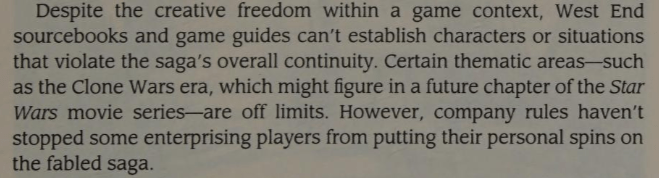
Despite the creative freedom within the game context, West End sourcebooks and game guides can’t establish characters or situations that violate the saga’s overall continuity. Certain thematic areas – such as the Clone Wars era, which might figure in a future chapter of the Star Wars movie series – are off limits.
– Mark Cotta Vaz, The Secrets of Shadows of the Empire, 1996, pg. 251
 Callum's Cantina